fiction.wikisort.org - Movie
Cape Forlorn is a 1931 British drama film directed by Ewald André Dupont and starring Fay Compton, Frank Harvey and Ian Hunter.[2] It was the English-language version of a British International Pictures multiple-language production with France and Germany which also made Le cap perdu and Menschen im Käfig. The film is also known as The Love Storm.
| Cape Forlorn | |
|---|---|
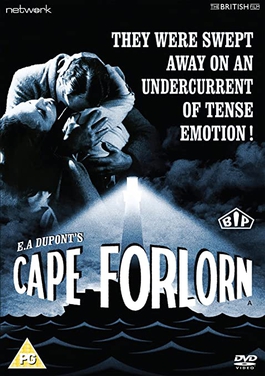 | |
| Directed by | Ewald André Dupont |
| Written by | Victor Kendall |
| Based on | Cape Forlorn by Frank Harvey |
| Produced by | Ewald André Dupont |
| Starring | |
| Cinematography | Walter Blakeley Jack E. Cox Claude Friese-Greene |
| Edited by | A.C. Hammond |
| Music by | John Reynders |
Production company | British International Pictures |
| Distributed by | Wardour Films |
Release date |
|
Running time | 86 minutes |
| Country | United Kingdom |
| Language | English |
| Budget | £50,000[1] |
Plot
A lighthouse on a lonely coast of New Zealand is looked after by lighthouse keeper William Kell. Kell marries Eileen, a dancer in a cabaret, who winds up having an affair with Kell's assistant, Cass. Eileen then begins flirting with a stranger, Kingsley, an absconder who is rescued from the wreck of a motor launch. Kingsley and Cass quarrel; the woman rushes upon the scene with a revolver, fires blindly, and Cass Is shot dead.
Cast
- Fay Compton as Eileen Kell
- Frank Harvey as William Kell
- Ian Hunter as Gordon Kingsley
- Edmund Willard as Henry Cass
- Donald Calthrop as Parsons
Original play
| Cape Forlorn | |
|---|---|
| Written by | Frank Harvey |
| Date premiered | Fortune Theatre, London |
| Place premiered | 30 March 1930[3] |
| Original language | English |
| Setting | A lighthouse off the New Zealand coast |
The movie was based on a play which premiered in 1930. It was written by Frank Harvey who appeared in the original cast.
Production
Shooting took place in late 1930[4] and it was made in English, French and German.[5]
Release
The film was originally banned in Australia by the censor[6] but this was overturned on appeal after a number of cuts were agreed upon.[7]
Reviews were poor.[8]
Shortly after the film was released in Australia, Harvey appeared in a production of the play at the Criterion Theatre in Sydney.[9] Harvey said this was in part because the film version had so changed his play.[10]
References
- "THE MOVIE WORLD". Bowen Independent. Vol. 26, no. 2195. Queensland, Australia. 6 December 1930. p. 7. Retrieved 27 August 2017 – via National Library of Australia.
- BFI.org
- ""STRONG MEAT"". The Daily News. Perth: National Library of Australia. 3 April 1930. p. 1 Edition: HOME FINAL EDITION. Retrieved 7 December 2012.
- "BRITISH FILMS". The Sydney Morning Herald. National Library of Australia. 5 December 1930. p. 17. Retrieved 7 December 2012.
- "UNORTHODOX". The Daily News. Perth: National Library of Australia. 27 March 1931. p. 11 Edition: HOME (FINAL) EDITION. Retrieved 7 December 2012.
- "FILMS BANNED". The Sydney Morning Herald. National Library of Australia. 10 April 1931. p. 9. Retrieved 7 December 2012.
- ""CAPE FORLORN."". The Sydney Morning Herald. National Library of Australia. 25 April 1931. p. 15. Retrieved 7 December 2012.
- "NEW FILMS". The Sydney Morning Herald. National Library of Australia. 4 May 1931. p. 5. Retrieved 7 December 2012.
- "Advertising". The Sydney Morning Herald. National Library of Australia. 18 August 1931. p. 2. Retrieved 7 December 2012.
- ""CAPE FORLORN."". The Sydney Morning Herald. National Library of Australia. 31 August 1931. p. 5. Retrieved 7 December 2012.
External links
- Cape Forlorn at IMDb
Другой контент может иметь иную лицензию. Перед использованием материалов сайта WikiSort.org внимательно изучите правила лицензирования конкретных элементов наполнения сайта.
WikiSort.org - проект по пересортировке и дополнению контента Википедии